I'd sit down with a blank page, feel the weight of expectation—this should be meaningful, this should be thoughtful, this should change my life, and then I'd close the notebook. The blank page won, and I walked away feeling worse than before.
I think a lot of people approach journaling this way. We treat it like a performance. Like there's a "right way" to do it. But here's what I've learned: journaling isn't about the writing. It's about what happens when you pay attention to your own patterns.
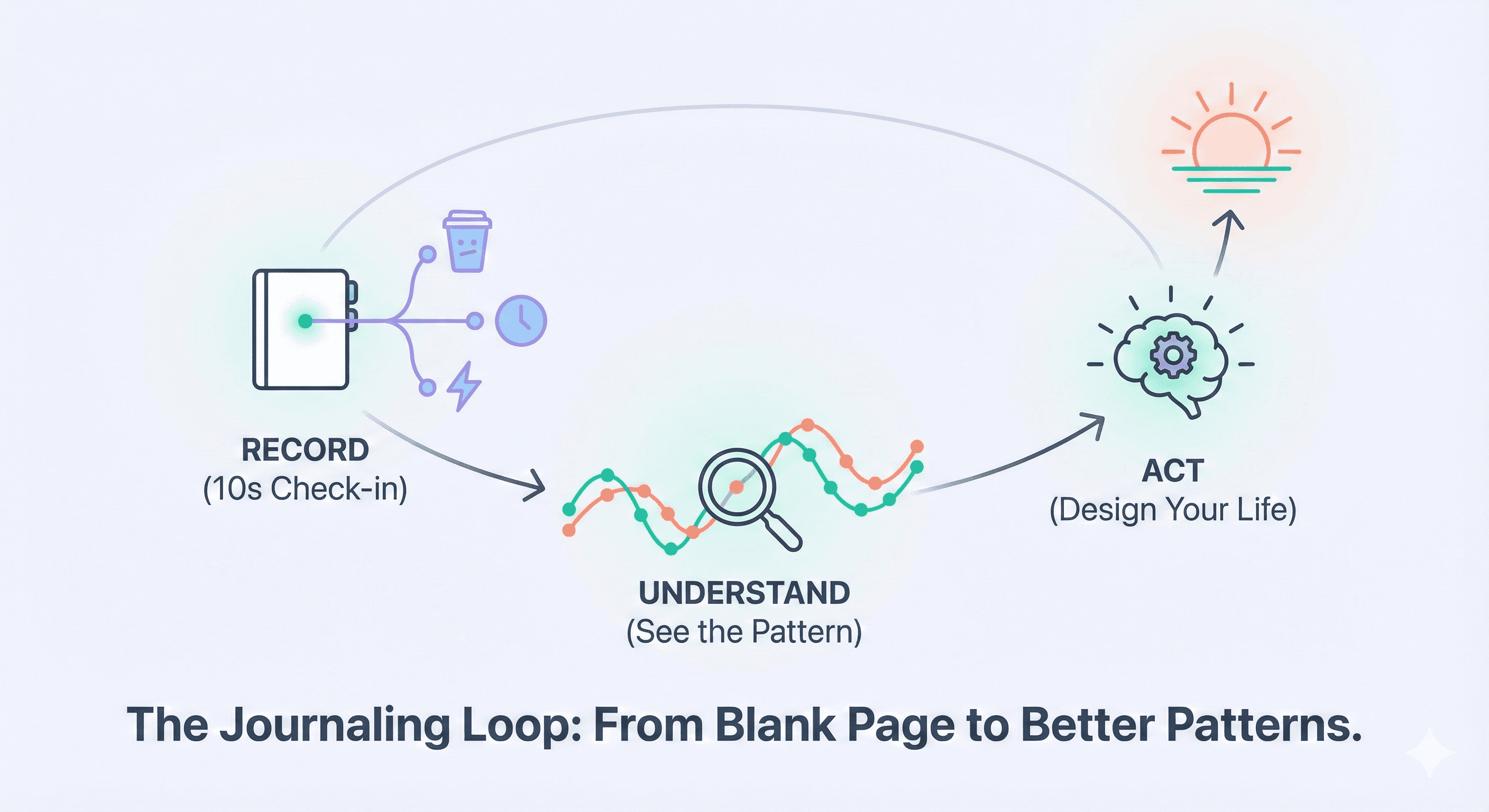
The Record → Understand → Act Loop
The real power of journaling isn't in the journaling itself. It's in what comes after. It's the moment you realize: Oh, I'm always exhausted on Tuesdays. Or: That meeting type consistently makes me feel drained. Or: I'm more creative when I'm alone in the morning.
These aren't profound realizations. They're practical ones. But they're only visible if you look.
Most of us move through our days on autopilot. We react to our calendar. We respond to urgency. We end the day and think, "I was busy, but did any of it matter?" We have no record of what actually moved us, what drained us, what energized us.
Journaling changes this. Not because writing things down is magical. But because it creates a record you can examine.
Here's what that looks like: You spend 10 seconds checking in. How am I feeling? What did I do? That's it. No pressure. No performance. Just a quick snapshot.
Then—and this is the important part—you step back and look at the data. You see the patterns. Not because you're journaling "correctly," but because you have enough data to see what's actually happening in your life.
That's when change becomes possible.
Speed Over Perfection
The reason journaling fails for most people isn't because they're not introspective enough. It's because the barrier to entry is too high. A blank page demands something. A 20-minute commitment feels luxurious when you're busy. Writing in "proper sentences" feels like another task.
What if journaling was 10 seconds? A quick check-in. A sentence. A mood. That's it.
This is the opposite of the romanticized journal. It's not a diary. It's a data collection system for your own life.
And when you have that data, when you can see your patterns clearly, something shifts. You stop guessing. You start knowing.
You know which activities energize you. You know which drain you. You know when you're at your best. And when you know these things, you can actually design your life around them, instead of just reacting to it.
That's not journaling. That's self-awareness.
And self-awareness is the first step to changing anything.
The blank page doesn't need to be your enemy. It just needs to be quick enough, easy enough, that you actually do it. And honest enough that when you look back, you see the truth.
That's when the real work starts.