Everyone's building AI features right now. Every app wants to use machine learning to solve your problems.
But here's what I've noticed: most AI wellness tools do the opposite of what they should. They observe your data and then prescribe solutions. "You're stressed on Mondays? Try meditation." "Your mood dips at 3pm? Drink more water." Generic advice dressed up in machine learning.
That's not AI for good. That's automation of mediocrity.
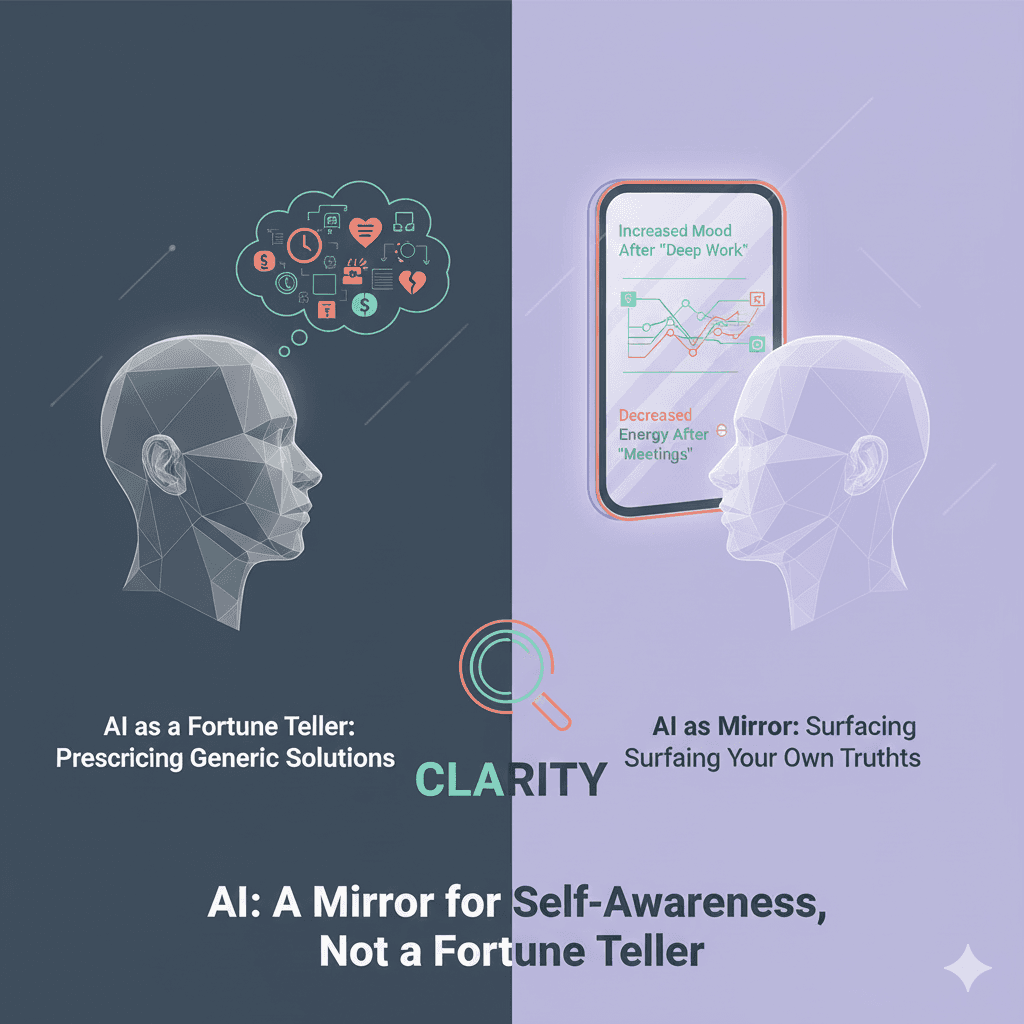
Real AI should do something different. It should help you understand yourself better—not replace your thinking. It should surface what's true about you, not tell you what to do.
AI as a Mirror, Not a Fortune Teller
The best use of AI in wellness isn't prediction. It's clarity.
You journal for 10 seconds. You write honestly. You move on. Then AI does something humans are terrible at: it looks at all your data and finds patterns you'd never see alone.
Maybe it's: "You've noted deep work 47 times in the past month. Every time you did deep work, your mood increased. Every time you had back-to-back meetings, it decreased."
That's not advice. That's observation. That's AI doing what it's good at: finding signal in noise.
Then you decide what to do with it. Maybe you block mornings for deep work. Maybe you batch meetings. Maybe you protect focus time. Or maybe you don't. It's your life.
Backed by Real Science
This approach isn't new. It's rooted in decades of research on expressive writing and emotional coherence.
James Pennebaker showed that writing about emotional experiences leads to measurable improvements in health and well-being. Not because writing is therapy. But because the act of translating experience into language changes how we process it.
More recently, research in affective computing shows that the gap between what you consciously feel and what your language reveals can be therapeutic. A trained eye can spot when someone is ruminating, suppressing, or avoiding. AI can do this at scale.
But here's the crucial part: the goal isn't to tell you what's wrong. It's to help you see it yourself.
Personalization That Actually Matters
Generic wellness advice fails because it assumes we're all the same. We're not.
What energizes a software engineer doesn't energize a marketer. What works on Monday doesn't work on Friday. What helps one person manage anxiety might make another person worse.
This is why personalization matters. Not because AI is smarter than you. But because your data is unique. And when AI looks at your unique data, it can help you see what's actually true about your life.
Then you do the hard part: you change.
AI Should Empower, Not Replace
The best technology gets out of your way. It shows you the truth and trusts you to act on it.
That's what good AI does. It listens. It observes. It reflects back what it sees. And then it trusts you to be the expert on your own life.
Because you are. AI is just helping you see it more clearly.